S&P Warns Big Tech $635 Billion AI Infrastructure Faces Energy Challenges
S&P Global warned that Microsoft, Amazon, Alphabet, and Meta's record $635 billion AI infrastructure spending faces a serious threat from surging energy costs driven by the Middle East crisis.

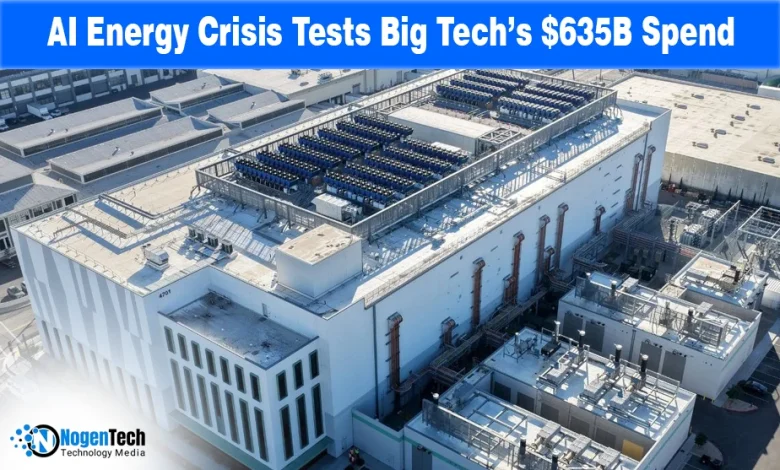
Big Tech is doubling down on AI infrastructure in 2026, with Microsoft, Amazon, Alphabet, and Meta planning around $635 billion for data centers, AI chips, and related projects. This figure is nearly six times the $80 billion spent in 2019, according to S&P Global, as cited by Reuters.
But rising energy costs are forcing analysts to warn of potential revisions to these ambitious plans, which could ripple across equity markets. The scale of this investment underscores the importance of sustainable energy commitments, linking to initiatives like the White House energy pledge, supporting cleaner and more reliable power. This leaves the future pace of AI infrastructure expansion increasingly uncertain.
How AI Data Centers Hit the Energy Wall
S&P Global Energy Horizons projects global data center power demand will rise 17% in 2026 and continue growing at 14% annually through 2030, reaching more than 2,200 TWh. This is not a gradual transition but a structural surge that existing grid infrastructure is not built to handle.
At CERAWeek 2026, Microsoft President Brad Smith said data centers are highly localized, with communities raising concerns over electricity, water, jobs, and taxes, making energy expansion complex.
He added that timelines may stretch beyond market expectations due to supply constraints, regulation, and regional bottlenecks.
The result: utility providers say it can take five to seven years to connect large-scale campuses to the grids, while tech companies are attempting to deploy hundreds of billions of dollars to deploy massive infrastructure far faster.
Why the Middle East Crisis Changes Everything
Melissa Otto of S&P Visible Alpha said that while tech companies have not yet signaled cutbacks in capital spending, continued high energy costs could force revisions, as reported by Reuters. If these costs are not reflected in earnings, it could trigger a broader market reaction.
S&P Global’s CERAWeek analysis also shows a divergence across sectors. Energy companies are seeing higher revenue and profit estimates, partly due to supply disruptions in the Middle East earlier this March.
The technology sector, however, has been slowing overall market growth due to worries about AI spending and whether software-based business models can continue driving profits.
MarketScreener noted that the $635 billion figure represents the low end of Big Tech’s guidance. At the upper range, spending could reach $665 billion, marking a sharp increase from 2025 levels and highlighting energy costs as a key external risk to these commitments.
Where Big Tech Is Moving Its AI Infrastructure
Big Tech is actively diversifying its data center footprint away from energy-constrained Western markets, as noted by Tech in Asia.
Microsoft, Google, and Amazon are investing in Malaysia, India, and Southeast Asia, where grids are more stable, electricity costs are lower, and permitting is faster than in the US or Europe.
At CERAWeek, Ruth Porat, President and CIO of Alphabet, highlighted that the US leads globally in AI models and chips, but not in energy, due to limited domestic infrastructure investment.
To address this gap, both Alphabet and Amazon confirmed plans to support grid upgrades to meet the growing power needs of their data centers.
This geographic diversification is not just a growth strategy. It also serves as a hedge against the energy shock S&P Global warns could derail the entire 2026 CapEx cycle.
Who the AI Energy Crunch Actually Affects
S&P Global noted that 38% of companies with data centers have yet to commit to sustainable tech and fully cut their carbon emissions, while data center power demand is expected to double in the next four years.
Rising energy costs hit these companies on two fronts: higher electricity bills squeeze margins on AI services, while the cost of building new data centers, including electrical upgrades, pushes CapEx beyond projections.
Reuters reported that Amazon plans about $200 billion in 2026 spending, Alphabet $175 billion to $185 billion, Meta $115 billion to $135 billion, and Microsoft $145 billion. Most of this is for AI chips, servers, and data center infrastructure.
For Nvidia, which supplies the bulk of GPUs for this expansion, S&P Global warned some CapEx may shift to 2027 and 2028, partly explaining its muted stock performance despite strong demand in products such as Vera Rubin.
What’s Next for Big Tech’s Energy Strategy
S&P Global noted that tech companies may delay some 2026 capital spending to 2027 or 2028, partly explaining Nvidia’s weaker stock performance this year. Despite these pressures, industry leaders still present AI investment as inevitable.
Behind the scenes, energy costs, grid limits, and Middle East supply concerns are adding caution to 2026 plans that were previously aggressive.
Analysts note that rising AI infrastructure demand and global energy pressures will challenge tech companies throughout 2026. How firms navigate these hurdles will determine which emerge as leaders in AI innovation, data center expansion, and future technology deployment.
Source: Big Tech’s $635 billion AI spending faces energy shock test