YouTube Begins Testing AI Assistant on Connected TVs
YouTube has begun testing its conversational AI assistant on smart TVs, allowing eligible users to ask contextual video questions directly.

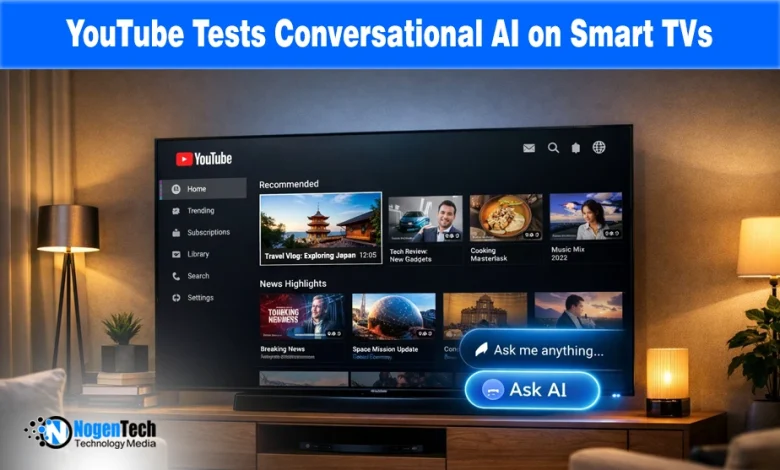
YouTube has started testing its conversational AI tool on smart TVs, gaming consoles, and streaming devices.
The limited rollout allows eligible users to ask contextual questions about videos directly from their television screens. The experiment expands a feature first launched in 2024 and reflects the platform’s continued push into AI-driven viewing experiences.
YouTube Confirms Limited TV Experiment
In a February 18, 2026, update on its official support page, Team YouTube confirmed that the conversational AI tool is being tested on connected TV platforms. The rollout applies to a small group of eligible users.
Those with access can select the “Ask” button while watching a video to open the AI assistant. Suggested prompts appear on screen, and users can also use their remote’s microphone button to submit voice questions. The AI responds without requiring viewers to exit the video.
YouTube provided examples such as asking about ingredients in a cooking tutorial or the background of a song’s lyrics. The company said it will share updates if the test expands further.
Broader Rollout Context and Industry Landscape
TechCrunch reports that the TV expansion builds on YouTube’s 2024 launch of the conversational AI tool across mobile devices and the web. The feature currently supports English, Hindi, Spanish, Portuguese, and Korean for users over 18 in the testing group.
The timing aligns with shifting viewing habits. According to a Nielsen report cited by TechCrunch, YouTube accounted for 12.4 percent of total US television audience time in April 2025, surpassing platforms including Disney and Netflix.
Other companies are advancing similar capabilities. Amazon has rolled out Alexa+ on Fire TV devices, while Roku has upgraded its AI voice assistant. Netflix is also testing AI-powered search. Moreover, YouTube has introduced additional AI features in recent months, including comment summaries, AI-enhanced search results, and a dedicated app for Apple Vision Pro.
Why This Matters
The expansion places conversational AI directly inside the television viewing environment rather than limiting it to mobile screens. As more users access YouTube through connected TVs, integrating AI tools into that interface may influence how audiences search for and what it means for the platform’s UX designs.
For YouTube, testing the feature on televisions provides practical insight into user behavior, voice interaction patterns, and on-screen engagement dynamics.
As living room viewing becomes central to platform growth, such experiments may influence future interface design and content navigation standards across the industry.
AI on The Big Screen
YouTube’s limited test marks the first time its conversational AI tool is being evaluated within the connected TV ecosystem. Although currently restricted to a select user group, the rollout extends the company’s AI roadmap to the fastest-growing screen segment.
The outcome of this trial will help determine whether conversational AI becomes a standard layer within YouTube’s television interface as competition intensifies across streaming platforms.