Gold has been the silent support of World of Warcraft. It spends on repairs, empty raid funds with flasks and enchants, and leaves a character either at the new content geared and comfortable or always in need of the most basic of necessities. That role has become even more complicated in the War Within era, where account-wide systems, crafted gear, and cosmetic sinks are competing over the same stack of coins.
To certain players, playing World of Warcraft is more or less a game within a game. They monitor prices, sell and buy, and make the auction house a stock market. Some just desire to have enough WoW gold to continue raiding, pushing keys, or playing rated PvP without having to worry about all repair bills. Their ability to balance it usually dictates the smoothness of the expansion.
This article highlights the mechanics of gold in the game and how the War Within era influences that flow and introduces external choices to players who are not able or willing to do everything manually.
How World of Warcraft Gold Actually Moves
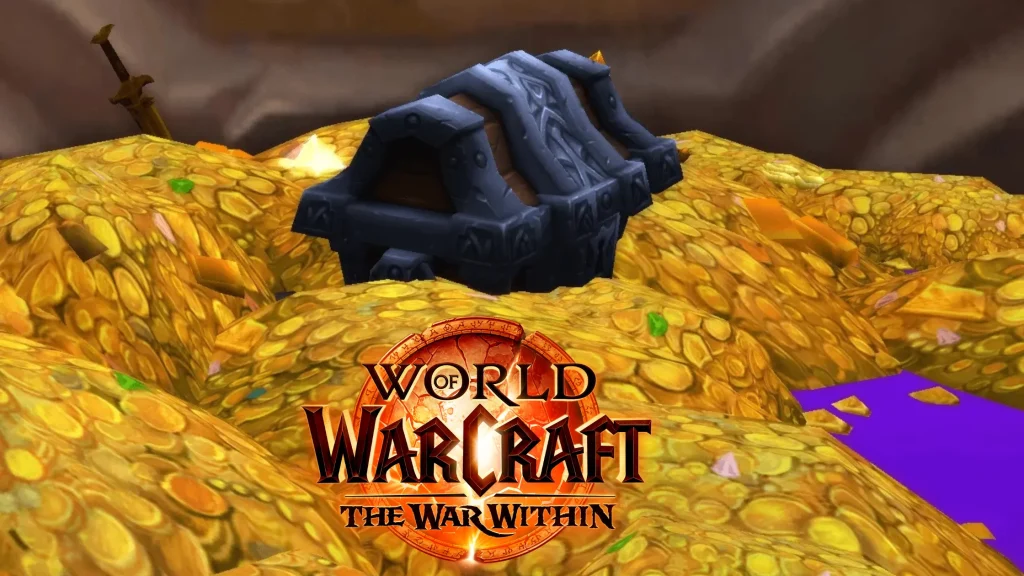
Under all the class guides and boss strategies, World of Warcraft is carried by a basic economic cycle: gold enters the game through the activities players accomplish, and it leaves the game through mechanisms that help strip the game of currency. The information varies with every expansion, though the fundamental framework has remained familiar over the years.
Gold Sources: Where the Currency Comes From
A majority of players make gold in a combination of both direct and indirect sources:
- Quest raw income, world content, and repeatables.
- Loot conversion, in which drops are converted to auctionable materials or items.
- Professional work, like crafting gear, consumables, or cosmetics for other players.
- Incidental rewards such as mission table or seasonal one-off rewards.
- WoW Token. Players with deep wallets can purchase game time tokens from the in-game shop and sell them on the Auction House.
In early leveling and casual play, raw income is typically sufficient to meet the basic expenses. The more the characters go into structured content, the more indirect sources become important. High-end players tend to develop routines of repeatable events that yield predictable quantities of World of Warcraft gold per hour instead of seeking random loot.
Gold Sinks: Where the Currency Disappears
The game continuously drains the economy by sinking to prevent the endless inflation of the economy. These include:
- Repair bills, flight paths, and other everyday expenses.
- Vendor mounts, transmo,g and cosmetic services.
The illustrations of well-known vendor mounts show the deliberate nature of these gold sinks. The Grand Expedition Yak, such as one example, would cost approximately 120,000 gold and include a repair and transmogrification vendor directly onto the mount of the player.
The Bloodfang Widow is even higher at 2,000,000 gold, provided by the Mad Merchant in Dalaran, and serves nearly solely as a show-off item. On the far end, the Mighty Caravan Brutosaur originally sold for 5,000,000 gold and then relocated to the Black Market Auction House, making it one of the most aggressive gold sinks in the history of the game of World of Warcraft.
- Profession expenses such as recipe purchases and crafting fees.
- Luxury comfort goods that are there just to absorb excess currency.
Expansions over time have added big prestige purchases, which are intended to be used by players who amass more gold than they can reasonably spend. Those sinks contribute to the stabilization of prices not only of the rare items, but also of the common items, such as flasks and food consumed by all groups.
Expansion Cycles and Inflation
Each expansion removes some of the economic game. New materials, recipes, and reward systems emerge, and old gold-making paths become outdated. The initial level of an expansion is more likely to cause acute pressure on some products, including the leveling consumables, early raid consumables and enchants.
This process has the side effect of inflation. The more players are at max level and optimized in their farming, the more WoW gold is added into the system. In the absence of corresponding sinks, the price will creep up, and the difference is felt most by latecomers.
Gold Pressure in The War Within Era
The War Within does not overwrite these basics, but it does introduce layers that affect the way players feel the gold pressure on a whole account.
Account-Wide Progression and Alt-Friendly Costs
The fact that systems treat an account as a single warband is good news to players having several characters, but it also emphasizes the cost of long-term engagement. Players can share mounts, cosmetics, and some progression features between the roster, but each individual character continues to have its own repair bills, enchants, and consumable needs.
This has led to a situation where many rosters are not straining on one main, but rather a number of characters that all require raid-readiness or Mythic+ readiness simultaneously. The availability of The War Within gold and expansion-branded WoW TWW gold packages on the player-driven market is a good sign that the multi-character reality, be it gold, is farmed or obtained in other ways.
Crafting, Consumables and Competitive Play
On the performance side, gold is tightly linked to progression:
- Both raiders and key pushers can have their gearing curve reduced by crafted gear and embellishments.
- Any serious environment must expect consumables like flasks, potions and food.
- Enchants and sockets complete a good piece of gear.
Players who engage in several competitive spaces simultaneously, raiding, Mythic+, and maybe even rated PvP, soon find themselves stretched in multiple ways by their World of Warcraft gold. Even people who are aware of effective farming techniques are not always able to follow the practice timetable, as it already takes the majority of their time in front of the computer screen.
External Options in the World of Warcraft Gold Ecosystem
At this stage, many players face a basic trade-off: to spend more time on farming or seek external means of bridging the gap. The latter will be tempting to those who already pay attention to their schedules.
Here is where buy WoW gold is seen as a constituent of the larger ecosystem and not a taboo subject. On the side of the player, it is logical. When an individual possesses more disposable income than time, it may seem more effective to use real money to decrease in-game grind than to reorganize work or family obligations.
Practically, this ecosystem is a range of behaviors and services:
- There are players who seek WoW gold for sale to complete last-minute purchases ahead of a new raid tier or season.
- Other people approach cheap WoW gold deals with skepticism, knowing that the prices are usually too low, which is associated with an increased risk and dubious origin.
- A wary crowd will take time to conduct research on the best place to buy WoW gold, by examining reputation, life-span and service as opposed to rushing to the first advert they see.
There is also expansion branding. Sellers advertise WoW TWW gold or offer packages around The War Within gold in particular, and base their marketing on whatever players are concentrating on at any given moment. No matter what it is named, it is still the same product; only the grind is not involved in the process of getting the extra WoW gold.
Analytically, this does not eliminate the necessity of economic literacy. Players need to determine the extent of gold required, the costs worth making, and additional spending worth value in terms of pleasure or progression, even in the case of external purchases.
Staying Smart With Gold in Current and Future Expansions
In the long run, effective gold management in World of Warcraft can hardly be reduced to a single trick. Rather, it is a mix of behaviors and choices that are in line with the goals and limitations of a player.
Disciplined players tend to:
- Establish routines for generating World of Warcraft gold whenever playing the game in normal mode.
- Do not buy impulsively what cannot help performance or enjoyment in the long term.
- Always have one eye on the bigger picture, and it is important to remember that every expansion comes with new sinks and new priorities.
The external options, such as the option to buy WoW gold, are also included in that framework as one more lever instead of a substitute for learning the game. To others, they are never essential. To others, they serve as a means of transforming real-life resources into time saved to allow the limited time spent playing games to work on challenging content rather than farming.
Final Words
During the period of The War Within and after it, the most healthy solution does not resemble the pursuit of all shiny things, but rather the view of gold as one of the various tools to mold the experience. Players should spend their resources the same way they earned them. They should use them based on real needs. When they do this, the economy stops feeling frustrating. It becomes a system they can learn, and they can master it at their own pace.