Tesla Smart Summon Clears US Regulatory Probe After Software Updates
The National Highway Traffic Safety Administration closed its Tesla Smart Summon probe after software updates resolved concerns, highlighting software as a primary regulatory response for AI driving systems.

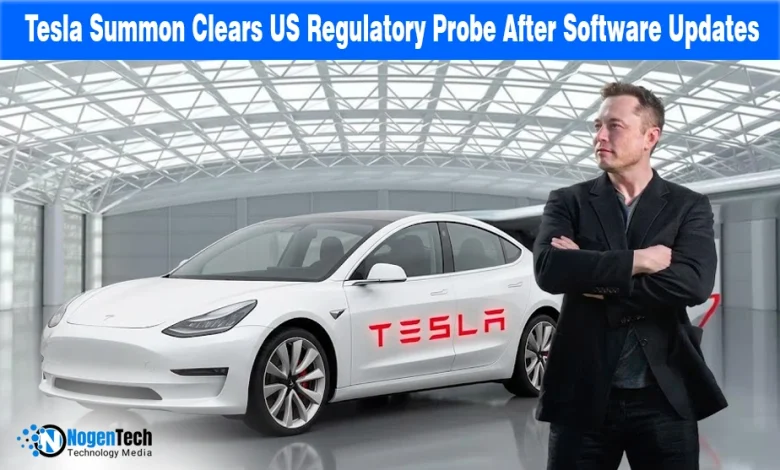
The National Highway Traffic Safety Administration (NHTSA) confirmed on April 6, 2026, that it has closed its preliminary investigation into Tesla’s Actually Smart Summon feature. The system lets owners move vehicles through parking lots or short distances using a smartphone app.
The probe covered about 2.59 million Tesla vehicles and began in January 2025 after the agency received crash reports linked to the feature. The closure highlights a growing US regulatory trend: federal safety concerns around driving assisted by artificial intelligence are increasingly being resolved through software updates instead of physical recalls.
What NHTSA Found and Why It Opened the Probe
The Wall Street Journal reported that NHTSA’s Office of Defects Investigation opened the preliminary evaluation after reports that Tesla vehicles failed to detect stationary objects, like posts and parked cars, in Summon mode.
The agency also reviewed media-reported incidents and a formal complaint, noting cases where drivers had too little time to stop before collisions because the feature moved faster than the line of sight allowed for intervention.
The reports noted that all incidents involved minor property damage with no injuries or fatalities. They occurred early in summon sessions and under poor visibility.
The feature operates at restricted speeds, limited to 3 mph beyond a defined range from the user, and relies on data labeling to detect objects accurately. The operator must hold a button in the Tesla app to keep the vehicle moving, which stops immediately when released.
How OTA Software Updates Resolved the Investigation
According to coverage from The Star, NHTSA credited Tesla’s over-the-air software updates for preventing the investigation from escalating.
This mirrors Tesla and NHTSA’s approach used in past cases: Tesla rolls out remote software improvements across its fleet, and NHTSA assesses whether they sufficiently address the issue without a formal recall or hardware change.
As Reuters noted, closing the investigation does not mean NHTSA concluded there were no safety defects. It is not a safety certification; rather, regulators determined that Tesla’s software updates did not require further federal review at this time.
The Broader Significance of AI Driving Systems
As CBT News reported, the probe’s closure comes as Tesla’s autonomous features face broader scrutiny alongside other autonomous vehicle companies.
NHTSA has separately escalated its Full Self-Driving investigation to Engineering Analysis, the stage usually before a recall, over low-visibility and traffic compliance concerns. That investigation covers more vehicles and remains active.
The Actually Smart Summon closure is feature-specific, not a blanket approval of Tesla’s autonomous software, showing regulators assess AI-assisted driving function by function.
This Summon feature occupies a legally distinct space: the vehicle moves without a driver present, but the owner retains remote control via the app while nearby, creating accountability that traditional recall rules do not fully address.
What Remains Under Active Scrutiny
Tesla’s Full Self-Driving system, still under NHTSA investigation, is now in the Engineering Analysis step. This probe covers about 3.2 million vehicles, addresses different behavior concerns than Actually Smart Summon, and proceeds independently.
The closure of Actually Smart Summon shows that Tesla’s over-the-air update model, sending software fixes to millions of cars without service visits, functions as a practical regulatory tool.
It speeds the process from problem detection to fleet-wide correction, part of Tesla’s broader innovations, including the upcoming Model Q EV.
For regulators, the focus is increasingly on how quickly and effectively a manufacturer can update AI behavior, not just what went wrong. In Smart Summon’s case, Tesla’s updates satisfied NHTSA to close the file.
Source: NHTSA Closes Probe Into 2.5 Million Tesla Vehicles Over