
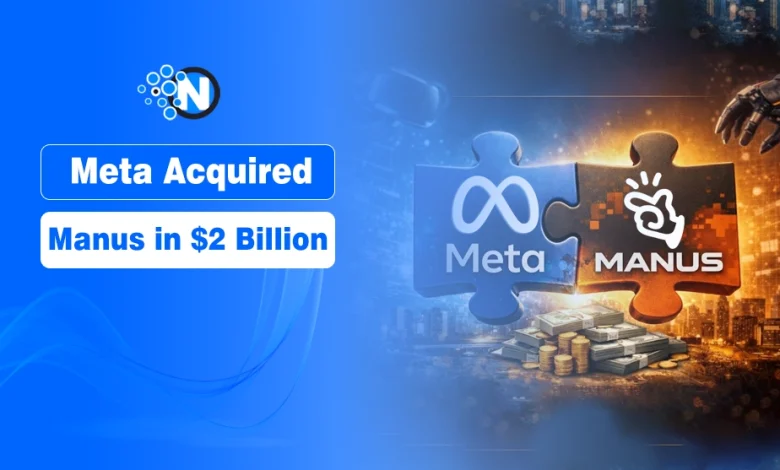
Meta has acquired Manus, an AI company known for building autonomous agents that complete real tasks instead of only answering questions, for more than $2 billion.
This move highlights a clear shift in Meta’s AI strategy. The company is moving beyond chat-based Artificial Intelligence and toward execution-driven intelligence.
But what problem will Manus solve for Meta, and how does Meta plan to use the acquisition to achieve better outcomes?
These are the questions many readers are asking. That is why this guide breaks down Meta’s broader AI vision and explains how Manus fits into the company’s long-term goals.
What Makes Manus Different From Typical AI Tools
Manus is designed around action-first AI, not conversation-first AI. That difference is what made it stand out before the acquisition.
Most AI tools stop at advice, summaries, or recommendations, but Manus goes further by turning those responses into real action. Its AI agents can plan tasks, break them into clear steps, and use external tools to complete the work.
This includes managing workflows, which handle repetitive operations and execute multi-step processes. Unlike traditional chatbots, Manus does not need constant human input. Once a task is assigned, the agent can operate independently with minimal supervision.
This focus on outcomes helped Manus earn strong user trust. It also attracted millions of paying users, proving demand for execution focused AI. For Meta, this fills a critical gap. It shifts AI from a system that talks to one that actually gets things done.

Manus is a Singapore-based AI startup known for its general purpose AI agent, often described as a digital employee. Manus’s AI agent is built to work autonomously. It can handle complex tasks such as research, coding, and data analysis with minimal human input.
Why Meta Wanted Manus
Meta already has powerful AI models, vast computing resources, and access to billions of users. What it has struggled to perfect is reliable task execution at a massive scale.
Most of Meta’s AI tools are strong at understanding language and generating responses. However, turning those responses into completed actions across real workflows is far more complex. This is exactly where Manus fits in.
Manus fills this gap by offering three things Meta could not easily build overnight.
First, autonomous task completion. Manus agents do not stop at recommendations. They plan, execute, and finish tasks with minimal supervision, which is critical for real-world automation.
Second, simple automation for non-technical users. Manus removes the need for coding or complex setup. Anyone can assign work to an AI agent, making automation accessible at scale.
Third, proven monetization and retention. Manus already runs a subscription-based model with millions of paying users. That traction proves people are willing to pay for AI that delivers outcomes, not just answers.
Together, these strengths give Meta something rare in the AI space. A system that combines intelligence, execution, and business viability. Replicating this internally would take years. Acquiring Manus accelerates Meta’s push toward agentic AI and positions it ahead in the next phase of AI adoption.
How Meta is Likely to Use Manus in the Future
Industry analysts expect Manus technology to be rolled out gradually across Meta’s ecosystem rather than launched as a standalone product.
In consumer apps like WhatsApp, Instagram, and Facebook, AI agents powered by Manus could move beyond simple replies. Users may be able to delegate real tasks such as organizing conversations, scheduling reminders, summarizing long message threads, or managing content workflows.
The focus would be on reducing manual effort inside apps people already use daily. For creators and professionals, Manus could support content planning, research assistance, analytics summaries, and automated posting. This would turn Meta’s platforms into productivity hubs, not just social networks.
On the business side, Manus strengthens Meta’s broader AI subscription strategy. Autonomous agents provide clearer, repeatable value compared to chat-only assistants. Businesses are more likely to pay for AI that saves time, completes tasks, and improves efficiency.
Over time, Manus may become the execution layer behind Meta AI. Instead of asking AI what to do next, users would simply assign work and let the system handle it. This shift positions Meta to compete in the growing market for agentic AI, where the goal is not conversation, but real outcomes.
Why Meta-Manus Deal Matters for the AI Industry
The acquisition signals a clear shift in how AI progress is being measured across the industry. For years, competition focused on who could build the smartest models or the most human-like conversations.
That phase is fading.
The next stage of AI competition is about execution. Users and businesses now want AI that completes real work, not just explains how to do it. This means handling tasks end-to-end, using tools, making decisions, and delivering outcomes reliably.
AI systems that cannot act will struggle to justify long-term value. By acquiring Manus, Meta positions itself early in this transition. Instead of waiting for agentic AI to mature, Meta is choosing to shape it. The deal also sets a signal for the broader market.
Autonomous AI agents are no longer experimental. They are becoming core infrastructure. In the coming years, AI platforms will be judged less by how well they talk and more by how well they work. Meta’s move suggests it understands that shift and is preparing for what comes next.



![Top Tech Stories of 9th Week [2026]](https://www.nogentech.org/wp-content/uploads/2026/03/Top-Tech-Stories-of-9th-Week-2026-390x220.webp)