Automated branding uses AI, APIs, and workflow automation to create, manage, and distribute a brand’s visual identity without manual effort. Built on a Single Source of Truth (SSOT), all assets—logos, colors, and tone of voice—are synchronized, version-controlled, and instantly updated across social media, ads, and digital channels.
So, drawing on global best practices, this system scales brand identity efficiently while preserving authenticity. In this article, i will show you that how automated branding enhances brand consistency, the AI tools that power it, and strategies to implement it effectively.
keyTakeways
- Automated branding uses AI and automation to create and manage brand assets consistently.
- It ensures logos, colors, typography, and messaging remain uniform across all channels.
- AI tools can generate multiple platform-specific visuals and personalized content automatically.
- Automated systems help maintain brand consistency, compliance, and reduce errors.
- Brands like Coca-Cola and Burger King use automation to scale campaigns efficiently.
How Automated Branding Improves Brand Identity
Automated branding tools significantly improve brand identity by ensuring visual and message consistency. The core value of automation lies in its ability to enforce perfection. By moving brand rules from a PDF into a digital environment, businesses can ensure their identity is always applied correctly.
Automating Logos, Colors, and Typography
Modern AI-driven design systems allow for the generation of “Responsive Identities.” Instead of a single static logo, automated tools generate variations optimized for different platforms—ranging from complex wordmarks for billboards to simplified favicons for mobile browsers.
Maintaining Brand Style Guides Automatically
Traditional style guides are often ignored because they are difficult to reference. Automated branding solves this by integrating the style guide directly into the design tools (like Canva, Figma, or Adobe Express). When a brand color or font is updated in the central registry, the change propagates to every saved template and active project file automatically.
Ensuring Consistent Visual Identity Across Channels
Consistency is the foundation of brand trust. Automated branding systems act as a “governance layer,” scanning outgoing content to ensure it aligns with the brand’s visual DNA.
By automating the distribution of assets, businesses can guarantee that a social media post in London and a digital ad in New York share the exact same visual language, reinforcing global brand recognition.
Visual Asset Automation
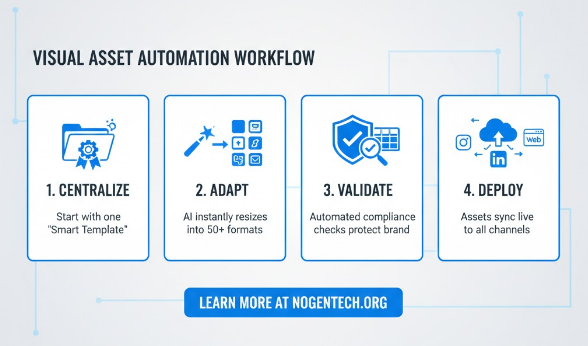
Beyond logos and typography, automated branding in recent times centers on Visual Asset Management (VAM). This is the process of using AI to transform a single creative concept into hundreds of platform-specific assets while maintaining pixel-perfect designs.
Automating Social Media Templates and Ad Creatives
The “one-size-fits-all” approach is obsolete. Modern teams use Multimodal AI (like Canva Magic Studio or Adobe Firefly) to ingest a single “Master Creative” and automatically generate:
- Vertical Video for TikTok and Reels.
- Static Carousels for Instagram.
- High-Compression Banners for Display Ads. Nowadays, these tools don’t just resize;
They use Image Harmonization to adjust lighting, shadows, and composition so that the product looks native to every environment while adhering to your Brand Kit.
Packaging and Product Design Automation
For e-commerce and retail, AI-driven automation now handles high-volume SKU management. Tools like Logo Diffusion can convert 2D brand marks into 3D product renders or packaging mockups in seconds. This allows businesses to A/B test packaging designs with digital twins before a single physical prototype is ever printed, significantly reducing the “Time-to-Market.”
Content and Messaging Automation
Today “Content is King,” but Context is the Kingdom. Automated messaging ensures that your brand speaks with one voice, even when generated by an algorithm.
AI-Generated Brand Messaging and Slogans
Advanced LLMs (Large Language Models) like Jasper or Custom GPTs are now trained on “Brand-Specific Weights.” You no longer use generic prompts; you use a Brand Voice Model. This ensures that every slogan, tagline, or product description aligns with your specific “Vibe”—whether that is “Luxurious and Minimalist” or “Energetic and Disruptive.”
Automated Content Personalization
Google prioritizes content that solves the “Personalization Paradox”: How do you talk to 1,000,000 people individually without losing your brand identity?
- Predictive Messaging: AI can analyze user behavior in real time and automatically adjust message tone.
- Adaptive Content: If a user is a “Value-Driven Shopper,” the automation engine emphasizes durability; if they are “Trend-Driven,” it emphasizes exclusivity—all while staying within the predefined brand lexicon.
Tools for Automating Written Content and Brand Communication
Lumen5 & Veo: Transform blog posts into branded video stories automatically.
Persado & Phrasee: Use mathematical linguistics to generate high-performing email subject lines and CTA copy that sounds human, but is optimized for conversion.
BrandGPTs: Internal AI assistants that act as “Brand Guardians,” ensuring every piece of written content, from a tweet to a whitepaper, passes a brand-alignment check before it is seen by a human.
Maintaining Brand Consistency with Automation
Recently, brand consistency is no longer a manual policing task; it is an integrated Governance Layer within your software stack. These systems now act as real-time guardians, preventing “Brand Drift” before assets reach the public.
These branding systems rely heavily on structured asset data, which is why automated metadata management plays a critical role in keeping brand assets searchable, compliant, and synchronized across platforms.
Automated Brand Compliance Checks
Static PDFs are being replaced by AI-driven Compliance Engines like IntelligenceBank and Rocketium. These tools automatically scan every asset—whether a social graphic or a 50-page report—to ensure:
- Visual Guardrails: Checks for exact HEX code matches, logo “clear space” violations, and approved font weights.
- Legal & Regulatory Safety: Platforms like Siteimprove and Ziflow scan for mandatory disclosures (e.g., “#ad” or legal footers) and ensure WCAG 2.2 accessibility compliance. As automated branding scales across regions and industries, AI-driven compliance and legal task automation becomes essential for managing disclosures, approvals, and regulatory requirements.
- Claims Substantiation: In regulated industries, AI auditors verify that all product claims match the latest approved messaging library.
Workflow Automation for Distributing Brand Assets
The “bottleneck” of asset requests is eliminated through Digital Asset Management (DAM) portals like Brandfolder, Bynder, and Frontify.
- Self-Serve Portals: Partners and internal teams access “locked” templates. They can change the text or image, but the core brand elements remain unmovable.
- Automated Syncing: Using Zapier, Make, or n8n, a logo update in your DAM can automatically trigger a replacement across your CMS, social media schedulers, and sales decks simultaneously.
AI-Powered Tools for Automated Branding
To move from manual design to an automated ecosystem, your “Brand Stack” must be categorized by function. In 2026, the most effective stacks are integrated, not just a collection of siloed tools.
AI Logo Generators and Brand Identity Tools
- Canva Enterprise: The 2026 “Magic Switch” and “Brand Hub” features allow teams to convert a single master design into 50+ localized formats with one click. It remains the top choice for non-designers due to its intuitive “locking” parameters that prevent brand violations.
- Adobe Firefly & Express: For professional teams, Firefly offers “Commercially Safe” generative AI. Its deep integration with Photoshop allows for Image Harmonization, ensuring AI-generated elements perfectly match your brand’s unique lighting and texture profiles.
- Looka & Brandmark: These remain the “gold standard” for startups, offering instant AI-generated Brand Kits that include everything from favicons to social headers based on a single brand DNA input.
Machine Learning for Personalized Branding
- Frontify: More than a DAM, Frontify provides “Living Brand Guidelines.” It allows developers to pull brand colors and assets directly via API, ensuring that if you change a brand color in the portal, it updates your website’s CSS automatically.
- Bynder: The enterprise choice for 2026, featuring AI-based Brand Governance. It automatically flags assets that don’t meet compliance standards or use outdated logos before they can be exported.
- Revuze: A new leader in 2026 that combines brand governance with Consumer Sentiment Intelligence, helping brands adjust their automated messaging based on real-time market perception.
Tools Suitable for Small Businesses, Startups, and Agencies
Jasper (with Brand IQ): Unlike generic AI, Jasper’s “Brand IQ” allows you to upload your style guide and past successful campaigns to create a dedicated Brand Voice Model. This ensures every output—from a tweet to a whitepaper—is indistinguishable from a human-written piece.
Synthesia & Lumen5: These are the primary tools for Automated Video Branding. Synthesia uses AI avatars to deliver branded corporate comms, while Lumen5 transforms blog posts into branded video stories with zero manual editing.
| Category | Top Recommendation | Best For… | Starting Price (Est.) |
| All-in-One Design | Canva Enterprise | Rapid, team-wide content scaling | $20/user/mo |
| Enterprise DAM | Bynder | High-volume governance & compliance | Custom Pricing |
| Identity Creation | Adobe Firefly | High-fidelity, commercially safe AI | $9.99/mo (Express) |
| Brand Intelligence | Revuze | Data-backed sentiment & positioning | Custom Pricing |
| Workflow Glue | Gumloop / Make | Connecting brand kits to distribution | Free to $37/mo |
Real-World Examples: Automated Branding in Action
To understand the power of automated branding, we must look at how global leaders and agile startups are using these systems to dominate their markets.
1. Coca-Cola: The “Share a Coke” Legacy Evolves
While originally a masterpiece of variable data printing, Coca-Cola’s “Share a Coke” campaign has evolved into a 2026 benchmark for Mass Personalization.
By using AI-driven digital twins and automated labeling, the brand now creates hyper-localized packaging that adapts to regional slang, names, and cultural events in real-time. This transition from “Mass Marketing” to “Mass Personalization” resulted in a recorded 7% increase in young adult consumption by making the product a tool for self-expression.
2. Burger King: The “Million Dollar Whopper” Contest
Burger King modernized its heritage by inviting fans to submit custom burger builds through a generative AI interface. The system didn’t just take an order; it automatically generated a high-fidelity AI preview of the creation, complete with a personalized jingle and branded background. This turned every customer submission into a “ready-to-post” social asset, effectively turning millions of users into automated brand ambassadors.
3. Startups and “Vibe Coding”
Small businesses in 2026 are using “Vibe Coding” tools (like v0 and Google AI Studio) to prototype branded apps and landing pages in minutes. A local coffee shop can now send personalized promotional graphics based on a customer’s favorite drink, a task that previously required a dedicated design agency.
Final Thoughts
In my experience, businesses that embrace automated branding early gain a significant advantage in consistency, efficiency, and scalability. By leveraging AI, workflow automation, and a Single Source of Truth, brands can maintain a strong, authentic identity across all channels without relying on time-consuming manual processes.
My recommendation is to start small—identify repetitive branding tasks that can be automated first, such as social media templates or content updates—and then gradually expand automation across your visual and verbal assets. Doing so not only saves time and reduces errors but also positions your brand to stay competitive and memorable in today’s fast-paced digital landscape.