Positron Scores $230M From Qatar To Rival Nvidia With Atlas Chips
Semiconductor startup Positron secured $230M in Series B funding to accelerate AI memory chips, challenging Nvidia, with the Qatar Investment Authority leading a Middle East AI infrastructure push.

The global race for AI hardware independence has shifted from a corporate rivalry into a geopolitical necessity. As Silicon Valley giants and sovereign nations alike scramble to secure the “brain power” of the future, Reno-based startup Positron has emerged as a critical beneficiary of this volatility.
By focusing on the high-speed memory bottlenecks that currently plague AI deployment, Positron is positioning its hardware not just as a tool, but as a strategic asset for those looking to exit the Nvidia ecosystem.
The TechCrunch Exclusive: Qatar’s $230M Bet on Sovereign AI
According to sources familiar with the matter, the Qatar Investment Authority (QIA) viewed the investment as a cornerstone of its “Sovereign AI” roadmap. During this week’s Web Summit Qatar in Doha, officials emphasized that controlling compute capacity is vital for economic survival.
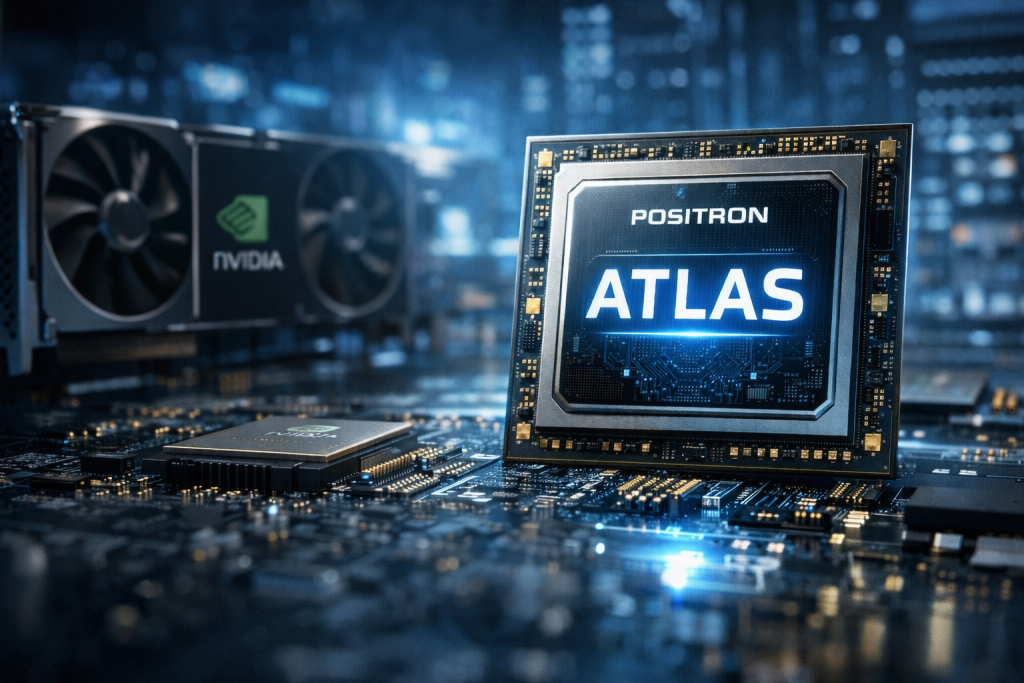
The funding will specifically scale the production of Positron’s first-generation Atlas chip. Manufactured in Arizona, the Atlas focuses on inference, the actual running of AI models, rather than the power-hungry LLM training phase.
This aligns with a 2026 market shift where enterprises are moving from building massive LLMs to deploying them at scale, where power efficiency becomes the primary metric for ROI.
OpenAI’s Growing Friction with Nvidia
While Positron celebrates its windfall, the backdrop is a growing rift between the world’s leading AI software firm and its primary hardware provider. As Reuters reported earlier this week, OpenAI has grown increasingly dissatisfied with the performance and power constraints of Nvidia’s latest chips for specific inference tasks.
Sources indicate that OpenAI has been actively seeking alternatives since last year to handle roughly 10% of its inference needs.
This dissatisfaction stems from the high latency in real-time applications like software development and video processing, areas where Positron claims its high-speed memory architecture offers a distinct advantage over Nvidia’s H100 and H200 series.
Breaking the GPU Monopoly via Memory Architecture
Positron’s CEO, Mitesh Agrawal, previously the COO of Lambda Labs, is leveraging a “disciplined scaling” strategy to disrupt the market. The startup argues that the current shortage isn’t just in GPUs, but in the memory bandwidth required to feed them.
By integrating memory more closely with the processing core, Positron’s Atlas systems are reportedly delivering 3.5x better performance per dollar than standard industry setups.
With the backing of QIA and previous investors like Valor Equity Partners and DFJ Growth, Positron is no longer a fringe player; it is a central figure in a global movement to decentralize AI power, one high-speed chip at a time.
Source: Exclusive: Positron raises $230M