Block Inc Cutting Thousands Of Jobs as Jack Dorsey To Embrace AI-Native Strategy

Jack Dorsey, CEO and co-founder of Block Inc., announced through his official X post a major restructuring that will cut roughly half of the company’s workforce. He described the move as part of a “strategic pivot to AI-native” operations.
As the parent company of Cash App and Square, Block highlights that the restructuring is designed to improve the efficiency of its intelligence tools and accelerate AI integration across its platforms.
While workforce reductions naturally raise concerns, the company frames this as long-term operational streamlining rather than reactive downsizing.
Here’s what happened, why Block is cutting 4000 jobs, and what this signals for fintech and the broader AI automation jobs landscape.
What Happened?
Block Inc layoffs represent one of the largest fintech workforce reduction announcements this year. According to Dorsey’s announcement, the cuts target roles that can be automated or consolidated as AI systems expand across:
- Fraud detection
- Risk modeling
- Customer support automation
- Internal data analysis
- Developer productivity tooling
The Jack Dorsey AI strategy focuses on reorganizing teams around AI-native workflows rather than layering it onto legacy structures.
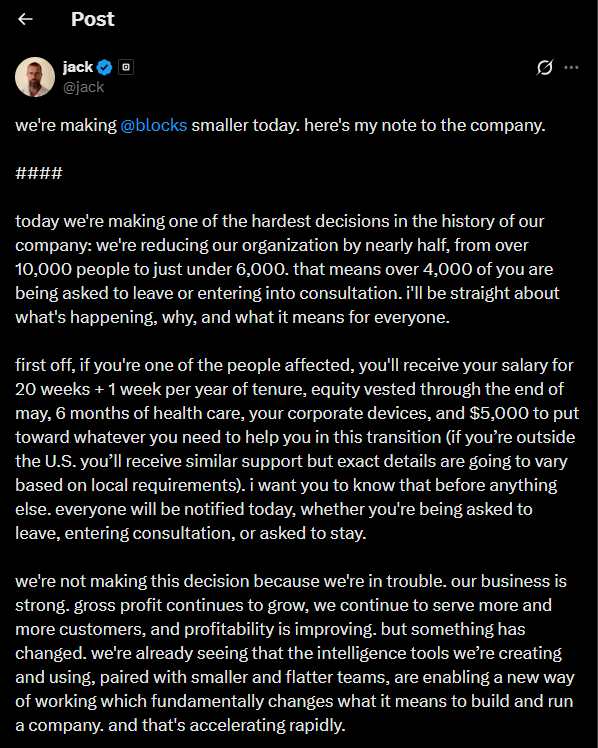
This restructuring affects multiple business units, including Cash App and Square operations. The company stated that impacted employees will receive structured severance support. While details vary by tenure and role, the severance package for Block employees includes compensation and transition resources consistent with industry standards.
Why It Matters Now
The timing is not accidental.
Fintech companies face tightening margins, regulatory complexity, and growing competition. Industry report from Deloitte notes that industry research from firms consistently shows enterprises prioritizing automation to improve cost efficiency and scalability.
This announcement directly reflects how AI is reshaping fintech jobs. The shift is no longer experimental, but it’s now operational.
The central question for leadership teams is no longer whether AI can assist workflows, but whether organizations can remain competitive without redesigning around AI-first architecture. This shift is now at the heart of the conversation about the future of work.
Who Is Affected?
Employees
Approximately 4,000 workers are directly impacted, leaving behind a workforce just below 6,000, as per CNBC. Many roles tied to manual review processes and operational coordination face automation pressure or role restructuring across the organization.
Developers and Engineers
Demand grows for AI systems engineers, data scientists, infrastructure architects, and governance specialists. Traditional technical roles may decline, but AI-focused positions are likely to expand.
Investors
Block’s stock price surged around 25% following the announcement, as per the Economic Times. This suggests investor approval of the efficiency-driven pivot, anticipating stronger performance & cost reductions from AI integration.
Consumers
Users of Cash App and Square may experience faster fraud detection, improved personalization, and reduced human-based support interactions.
Industry Context: How AI Is Reshaping Fintech Jobs
The fintech workforce reduction trend extends beyond a single company. Across financial services, automation now handles:
- Real-time transaction monitoring
- Compliance documentation generation
- Credit scoring optimization
- Customer interaction triage
Fintech transformations over the years indicate this is a structural inflection point rather than a cyclical correction. Just as cloud computing reshaped infrastructure and mobile technology changed user behavior, AI is now redefining workforce architecture.
Impact Analysis
The strategic shift carries implications across markets, workforce dynamics, and customer experience.
Market Impact
Block’s strategic pivot to AI-native may influence competitors to accelerate similar restructuring efforts. Efficiency-driven AI adoption has become a key valuation driver.
If the efficiency of intelligence tools translates into margin improvement, the company could strengthen long-term investor confidence.
Workforce Impact
Internally, the implications are more complex and longer-term. The short-term disruption is significant. But long-term effects depend on reskilling and talent redeployment across AI-focused roles.
Customer Impact
For end users, the changes manifest through service delivery and interaction models. Consumers benefit from improved automation speed and fraud prevention accuracy. However, reduced human touchpoints may alter service experiences.
Short-Term vs Long-Term Effects
Short-Term
- Workforce disruption
- Operational restructuring
- Positive investor sentiment
- Increased scrutiny of AI automation jobs
Long-Term
- Leaner AI-native fintech model
- Institutionalized automation
- Redefined job market requirements
- Stronger alignment between product and machine intelligence
If successful, Block’s model could become a case study in fintech AI transformation.
Step-by-Step Breakdown: How the AI Pivot Works
1. Assessment
The company identifies repetitive, rule-based tasks suitable for automation through internal operational reviews.
2. Integration
AI systems are deployed into those workflows to replace or support manual processes.
3. Organizational Redesign
Teams are restructured around AI-enabled operations, with engineering and data functions taking a central role.
4. Governance
Oversight frameworks are implemented to monitor AI performance, manage risk, and ensure regulatory compliance.
5. Optimization
Models are continuously refined to improve accuracy, efficiency, and cost performance over time.
This sequential process reduces redundancy, increases scalability, and embeds AI into core operations.
Expert Insight and Industry Perspective
According to a Forbes fintech analysis Across the fintech sector, leaders increasingly argue that AI transformation requires structural redesign rather than incremental upgrades. Jack Dorsey’s approach aligns with this view, emphasizing rebuilding organizational architecture around AI-native systems.
Automation is often framed as short-term cost-cutting. In reality, enterprise AI transformation demands sustained infrastructure investment and structural change. The market appears to recognize that distinction, reflected in Block’s post-announcement stock surge.
Common Misconceptions
“AI is eliminating all fintech jobs.”
AI shifts skills and automates repetitive tasks, but creates demand for technical and analytical roles.
“This is purely cost-cutting.”
AI reduces redundancies, yet enterprise adoption requires significant infrastructure and investment.
“Automation reduces innovation.”
Properly deployed AI accelerates product iteration, enhances insights, and frees teams for high-value creative work.
Future Outlook
Several developments are likely:
- Expanded AI integration across Square merchant analytics
- Deeper automation within Cash App compliance systems
- Increased hiring for specialized AI roles
- Greater industry-wide focus on the efficiency of intelligence tools
The future of work will likely involve hybrid human-AI operational models rather than fully autonomous systems. Previous technology cycles often sparked initial fear before stabilizing into new opportunity patterns. This moment appears to follow a similar trajectory, only faster.
When Not to Rely on Social Media
If you encounter claims promising:
- Guaranteed AI profit margins
- Instant workforce replacement
- “Zero-disruption” automation
Pause. Large-scale AI transitions are complex and require governance, infrastructure, risk management, and regulatory oversight. Instead of relying on social media claims, always verify information through official company disclosures and reputable financial reporting.
What’s Your Take?
Do you believe the fintech workforce reduction tied to AI automation jobs represents necessary modernization?
How is your organization preparing for the future of AI work in 2026?
If you work in fintech or AI development, your perspective matters. Share your insights; this transformation is unfolding in real time.
How The News Was Verified
- Reviewed the official announcement from Block CEO Jack Dorsey Inc regarding restructuring plans.
- Cross-referenced reporting from established financial and technology media outlets, CNBC, Forbes, and others
- Analyzed market reaction data following the Block stock price surge
- Consulted industry research from firms such as Gartner and S&P Global regarding AI automation and enterprise restructuring trends
Reviewed CISA guidelines for responsible tech journalism