
You are sitting in front of a recruiter for your dream company. Before discussing the role, she slides an NDA (also known as a non‑disclosure agreement, NDA) across the table. You sign it without reading closely; most people do. Three months later, you mention an internal product roadmap to a friend in the industry. That conversation just became potentially expensive.
This scenario plays out thousands of times weekly. Yet most people can’t answer a fundamental question: Is the agreement you signed actually enforceable?
The answer isn’t a simple yes or no. It’s strategically important because confidentiality agreements sit at the intersection of contract law, business practice, and risk management. Understanding their enforceability directly impacts how you navigate employment, partnerships, and transactions. This is also why modern contracting systems now prioritize NDA tracking, because legally binding obligations require systematic monitoring.
This blog post explains why a Confidentiality Agreement is legally binding and what happens when it is breached.
What Makes a Confidentiality Agreement Legally Binding?
A confidentiality agreement is legally binding when it satisfies the core requirements of contract law. Unlike casual agreements, an NDA must contain specific elements to hold up in court.
The foundation rests on four pillars:
- Consideration – Both parties must exchange something of value. The employer gains protection of trade secrets; the employee gains employment or access to information. This mutual exchange is what transforms a document from a wish list into a legal obligation. Without it, courts typically won’t enforce the agreement. Understanding consideration in contract law is essential because many poorly drafted NDAs fail here.
- Mutual Consent – Both parties must knowingly agree to the terms. Signing under duress, misrepresentation, or without reasonable opportunity to review weakens enforceability. Courts examine whether the agreement was presented fairly and whether both sides understood what they were accepting.
- Reasonable Scope – This is where most NDAs fail. The agreement must protect legitimate business interests without being overbroad. An NDA that prevents you from ever discussing anything you learned during employment, even years later, typically violates public policy. Courts scrutinize whether the restrictions are necessary and proportional to the legitimate interest being protected.
- Legal Purpose – The agreement cannot require illegal activity or restrain trade unfairly. An NDA designed to prevent whistleblowing on workplace safety violations, for instance, is unenforceable because public policy protects such disclosures.
These aren’t theoretical abstractions—they’re the actual framework judges use. When Alphabet sued former employees for violating their NDAs in 2022, the court examined each element. The case succeeded because Google demonstrated all four pillars were satisfied.
Where Enforceability Breaks Down
Not all signed confidentiality agreements are created equal. Courts have rejected thousands of them on specific grounds.
- Overbroad restrictions represent the most common vulnerability. If an NDA prohibits discussing “anything learned during employment,” courts often strike it down as unreasonably restrictive. The same agreement worded to protect “proprietary customer lists and pricing strategies” is typically enforceable because the scope is defined and specific.
- Lack of legitimate business interest is another fatal flaw. An NDA protecting information already in the public domain doesn’t qualify. Similarly, agreements preventing discussion of wages, working conditions, or general industry practices conflict with labor law protections in most jurisdictions.
- State and jurisdictional differences dramatically affect enforceability. California courts are notoriously hostile to restrictive covenants, often striking down non-competes and broad confidentiality clauses. Texas courts, by contrast, enforce them more readily if reasonably tailored. The same NDA signed in California and Texas may be enforceable in one state and unenforceable in the other.
This variance is why contract compliance tracking systems now flag jurisdictional requirements. A global organization managing NDAs across multiple countries must account for these nuances or risk unenforceability.
What Happens When an NDA is Breached
Understanding the legal consequences of violation is where the real stakes emerge. NDAs aren’t theoretical—they’re enforcement mechanisms with tangible remedies.
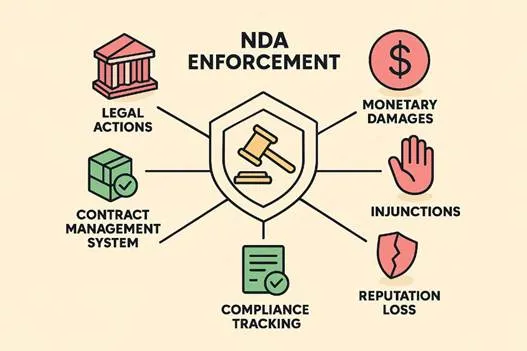
- Injunctive relief is the most aggressive remedy. Rather than waiting for damages, the employer seeks a court order immediately stopping the breach. If you’re disclosing proprietary information, the company can ask a judge to halt you before more damage occurs. These orders move quickly in confidentiality cases because the harm is often irreversible.
- Monetary damages follow if the breach causes financial loss. The company calculates harm—lost competitive advantage, market share erosion, development delays—and seeks compensation. In high-profile cases, damages have reached millions. Snap Inc. won a $100 million judgment against a former executive who violated his NDA.
- Breach implications extend beyond legal fees. Your professional reputation, future employment prospects, and personal liability are all at risk. Companies now conduct thorough background reviews; a history of NDA violations follows you through your career.
The enforcement mechanism itself has evolved. Contract monitoring systems now alert organizations to NDAs approaching expiration, enabling proactive renewal before obligations lapse. This systematic approach transforms abstract obligations into managed risks.
The Role of Contract Management in NDA Enforcement
Here’s where the practical reality intersects with legal frameworks: most NDA breaches occur because organizations lose track of their agreements. An employee doesn’t remember signing an NDA. A contractor believes their obligations expired. A business partner assumed the agreement terminated after the deal closed.
Modern contract risk management systems solve this through automated tracking. They maintain centralized repositories of all NDAs, flag expiration dates, and alert relevant stakeholders when obligations activate or terminate. For organizations managing hundreds or thousands of NDAs, this infrastructure is the difference between enforceability and chaos.
The system works like this: when an NDA is executed, the contract management system extracts key dates, parties, and restriction scopes. It then triggers notifications as termination approaches, ensuring timely renewal decisions. When a breach claim emerges, the system provides immediate access to the exact agreement, dated signatures, and compliance history—evidence that holds up in court.
This integration of legal obligation with operational infrastructure has become the modern standard for elements of contract management. Companies no longer treat NDAs as static documents; they’re dynamic obligations requiring systematic oversight.
The Bottom Line
Yes, confidentiality agreements are legally binding—when drafted properly, signed by capable parties with mutual consent, and addressing reasonable, legitimate business interests. But legality and enforceability aren’t automatic. They require careful drafting, appropriate scope, jurisdictional alignment, and, critically, ongoing management.
The most binding NDA is worthless if your organization forgets it exists. The most aggressive legal language becomes unenforceable if it overreaches. Success requires balancing legal rigor with practical reasonableness, and maintaining that balance over time through systematic contract lifecycle management.
Before signing any confidentiality agreement, ask yourself: Is this reasonable? Is it specific? Does it protect legitimate interests without restricting information I should be free to discuss? And if you’re an organization enforcing NDAs, ensure your agreements are actively monitored and systematically managed.