HubSpot vs Zendesk: Which Customer Service Platform is Better in 2026?
Zendesk is best for teams that need powerful, scalable customer support tools, while HubSpot is ideal for businesses wanting CRM-driven service connected to sales and marketing.

A staggering 88% of customers say they’re more likely to make a repeat purchase after a superior support experience. This state underscores how critical effective customer service software has become for growth and loyalty.
As companies of all sizes double down on support tech, two names consistently top the list: HubSpot and Zendesk.
However, while both platforms aim to elevate your customer service operations, they take very different approaches: one positions itself as a unified CRM-centric growth engine. At the same time, the other focuses on being a dedicated support powerhouse.
So, what should you choose: Zendesk vs HubSpot? This guide compares their features, ease of use, pricing, and long-term value so you can choose the best platform for your business in 2026.
HubSpot vs Zendesk: Comparison Table [TL;DR]
Start creating Verdict in seconds, and convert more of your visitors into leads.
HubSpot vs Zendesk: Feature Comparison in 2026
These are the features of HubSpot and Zendesk that help businesses provide their customers with exceptional customer service:
1. Core Customer Support Features
Zendesk is built first and foremost as a helpdesk platform. It offers powerful ticketing, advanced workflows, service level agreements, macros, triggers, and deep queue management, which makes it ideal for large or fast-moving support teams.
Its system is designed to handle high volumes of customer requests with precision and automation.
HubSpot Service Hub also provides ticketing, shared inboxes, live chat, and customer feedback tools, but its biggest strength is how these features connect directly to its CRM. Every support interaction automatically links to the customer’s sales and marketing data, giving agents full context without switching platforms.
2. CRM and Customer Data Management
HubSpot has a major advantage here. Its Service Hub runs on top of HubSpot’s native CRM, meaning support, sales, and marketing teams all work from the same customer record. This makes it easier to personalize support, track the customer journey, and identify upsell or retention opportunities.
Zendesk, on the other hand, focuses more on service operations than full CRM. While it does offer sales and customer data tools, many companies integrate Zendesk with external CRMs like Monday and Salesforce to get a complete customer view.
3. Automation and AI Capabilities
Zendesk leads in support-specific automation. It uses AI to route tickets, suggest replies, summarize conversations, and help agents resolve issues faster. These features are especially valuable for large support teams dealing with complex workflows.
HubSpot’s automation is broader but simpler. Its workflows can automatically trigger emails, assign tickets, update records, and move customers through pipelines. While it is not as deeply tuned for support logic as Zendesk, it is easier for non-technical teams to manage.
4. Knowledge Base and Self-Service Tools
Zendesk offers one of the most advanced knowledge base systems in the customer support industry. You can organize articles into detailed categories, offer multilingual help centers, and surface relevant answers automatically during chats.
HubSpot also provides a strong knowledge base with easy publishing tools and AI-assisted content creation. It integrates well with chatbots and customer portals, making it a solid option for businesses that want to reduce support load through self-service.
5. Reporting and Analytics
Zendesk delivers highly detailed support analytics, including ticket resolution time, agent performance, channel performance, and customer satisfaction scores. These reports are designed specifically for managing and optimizing customer service teams.
HubSpot’s reporting is more business-wide. It shows how support impacts retention, revenue, and customer lifetime value, which is great for leadership and growth teams, though it may lack some of Zendesk’s granular support metrics.
6. Best Use Cases
Zendesk is best for companies that run high-volume, complex support operations and need deep workflow control, automation, and reporting.
HubSpot is ideal for businesses that want customer support tightly connected with sales and marketing, especially growing companies that care about customer experience across the full lifecycle.
Zendesk vs HubSpot: Pricing Comparison
Choosing the right customer service solution isn’t just about features, but it’s also about cost, scalability, and long-term ROI. Here’s a clear breakdown of how Zendesk and HubSpot Service Hub stack up on pricing in 2026 so you can budget wisely and avoid surprises.
Pricing Overview: Plans and Tiers
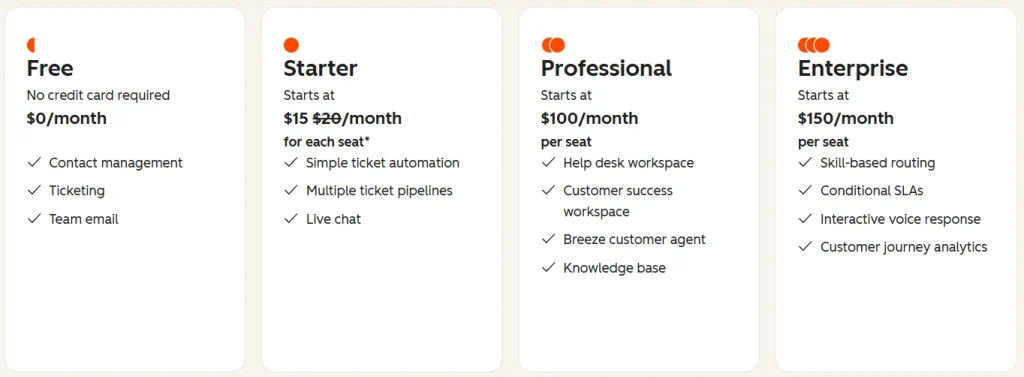
HubSpot Service Hub offers a range of plans designed to grow with your business:
- Free: $0/month – includes basic ticketing, shared inbox, and CRM integration for up to a few users.
- Starter: Starts around $15 per seat/month – ideal for small teams ready to standardize support workflows.
- Professional: Around $100 per seat/month – adds help desk workspace, knowledge base, AI tools, and automation.
- Enterprise: Around $150 per seat/month – advanced features like conditional SLAs, skill-based routing, and deeper analytics.
HubSpot’s paid tiers often require annual billing, and onboarding fees can apply at higher levels, especially for Professional and Enterprise plans.
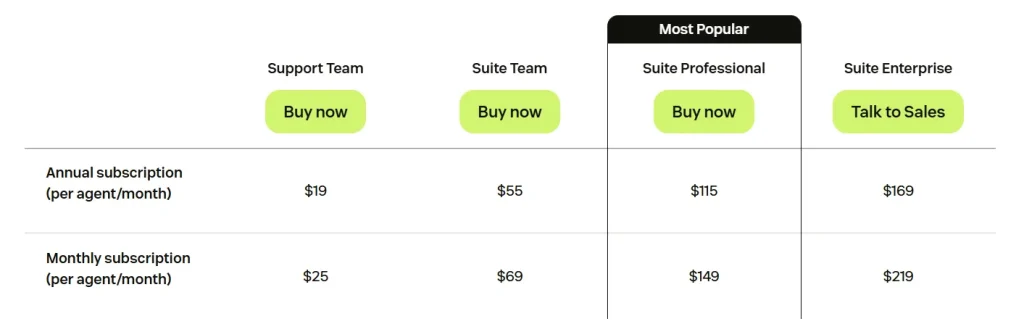
Zendesk takes a more modular pricing approach focused on support use cases:
- Support Team: About $19 per agent/month – basic ticketing and email support.
- Suite Team: $55 per agent/month, adding multichannel support features and more customization.
- Suite Growth: $89 per agent/month – expanded automation and workflow options.
- Professional & Enterprise Plans: Typically $115+ per agent/month with advanced analytics, AI tools, and enterprise-grade controls (exact pricing often requires contacting Zendesk sales).
Both platforms offer free trials or limited free tiers, so you can test before committing.
What Should You Choose: Zendesk vs HubSpot?
Choosing between Zendesk and HubSpot Service Hub ultimately comes down to your business goals, team structure, and long-term strategy. Both solutions are powerful, but they shine in different scenarios, and the right choice depends on what matters most to you.
Choose Zendesk If Your Priority is Best-in-Class Customer Support
Zendesk has built its reputation as a specialized, purpose-built customer service platform with deep support capabilities. It offers advanced ticketing workflows, automation, intelligent routing, and industry-leading support features designed to handle high volumes and complex support processes.
This makes it a strong choice when your core focus is delivering outstanding customer service at scale. Zendesk’s strength lies in its support-centric design, which makes it ideal for businesses that want a dedicated support solution with mature tools and flexibility.
Choose HubSpot Service Hub If You Want Unified CRM-Driven Support
HubSpot Service Hub takes a different approach by embedding customer service into a broader CRM ecosystem. This means support isn’t just about solving tickets, it’s about understanding the whole customer journey.
With tight integration across sales, marketing, and service, HubSpot lets teams collaborate better and gives agents deeper context on every interaction. For businesses aiming to connect support with revenue growth, retention, and coordinated cross-team workflows, this CRM-first strategy can be a game-changer.