Moltbot Emerges After Clawdbot Rename as Viral AI Agent Sparks Security Debate
Moltbot, formerly Clawdbot, is a viral AI agent that sparked debate by offering powerful automation capabilities. Its deep system access excites developers but also raises serious security concerns in the tech community.


The viral personal AI assistant once known as Clawdbot has officially rebranded itself as Moltbot, shedding its original name just as quickly as it gained internet fame. The rename follows trademark pressure linked to Anthropic’s “Claude” brand, but the controversy surrounding Moltbot now extends far beyond its name.
From Overnight Sensation to Forced Rebrand
Clawdbot exploded in popularity after developers shared clips of the AI autonomously completing tasks across browsers, files, and messaging apps. Unlike typical chatbots, it could act by clicking buttons, running commands, and chaining actions without constant human input.
That momentum was interrupted when its creator confirmed a required name change following trademark concerns connected to Anthropic’s Claude ecosystem, as mentioned in Forbes. Within days, Clawdbot became Moltbot, a name meant to signal evolution rather than retreat.
What Moltbot Actually Does
Moltbot’s rise mirrors a broader shift toward AI assistants that can operate directly inside everyday tools, similar to how Salesforce’s new Slackbot is reshaping automated work inside Slack.
Moltbot is not a consumer-friendly AI assistant in the traditional sense. It is an agentic AI system designed to operate locally, often with deep system permissions.
Users can connect Moltbot to:
- Web browsers
- File systems
- Messaging platforms
- APIs and automation scripts
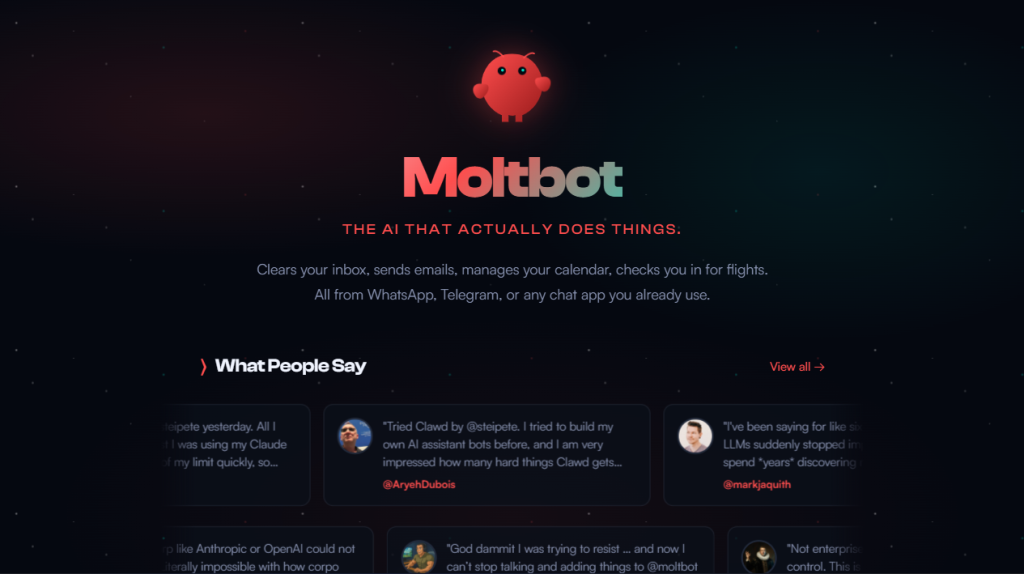
This architecture allows it to perform real-world actions rather than simply generate text. As noted by TechCrunch, its tagline describes it as “an AI that actually does things,” a framing that helped fuel its viral adoption among developers and automation enthusiasts.
But that same power is also what alarms security experts.
Security Researchers Call the Risks “Spicy”
Moltbot’s deep access model could expose users to serious security vulnerabilities if misconfigured or exploited.
Because Moltbot often runs locally with elevated permissions, a compromised agent could:
- Access sensitive files
- Execute malicious commands
- Leak credentials or API keys
Experts have acknowledged these risks, advising users to treat AI agents such as Moltbot like “a junior employee with admin access” rather than a harmless chatbot.
Security researchers argue that many early adopters underestimate what they are granting an autonomous agent behind the scenes.
Open-Source Freedom vs. Safety Guardrails
Supporters argue that Moltbot represents the future of open, user-controlled AI, especially as large platforms tighten restrictions and moderation.
Critics counter that releasing powerful agents without default guardrails invites misuse, intentional or not.
This tension mirrors broader industry debates around AI autonomy, regulation, and responsibility.
While platforms like OpenAI increasingly implement behavioral safeguards and identity checks, tools like Moltbot move in the opposite direction, prioritizing flexibility and local control.
Main Source: viral personal AI assistant Clawdbot (now Moltbot)