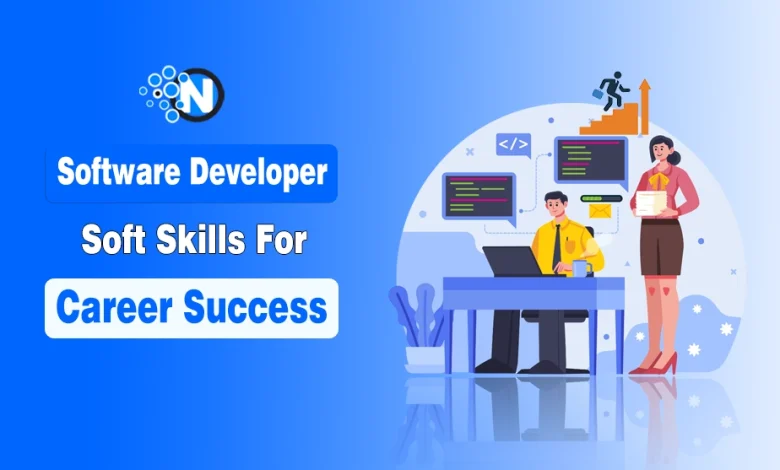
Soft skills for software developers are no longer a career bonus – they are a baseline requirement. Technical skills get you an interview; the ability to communicate clearly, adapt fast, and work effectively with others is what builds a long-term career.
As AI tools absorb more routine coding tasks, the human side of engineering – judgment, collaboration, and clear thinking – is rising in importance for every developer on the market today. These are the soft skills needed for a software engineer that separate great developers from average ones.
If you want to hire software developers or build a distributed team anywhere in Eastern Europe, you will notice that developers who stand out consistently are not always the strongest coders in the room. They are the ones who communicate clearly, manage their time without being pushed, and keep the team aligned as pressure builds.
Why Soft Skills Matter More Than Ever in 2026
Software development has changed a lot in the last two years. AI coding assistants can write boilerplate code, write documentation, and even develop test units.
What they can’t do is negotiate the scope of sprints with the product manager, defuse conflicts arising between two senior engineers, or explain a technical decision to a non-technical person in just three sentences. This responsibility lies with the developer, underscoring the importance of developing soft skills for success as a software engineer, particularly for teams that hire software developers in Romania.
According to Business Insider, AI-based automation of technical skills has shifted the recruitment process toward evaluating soft skills, especially in organizations that adopt AI-driven processes. In this regard, engineering managers place more importance on soft skills such as communication and teamwork than on knowledge of frameworks in potential candidates.
Communication Skills for Software Developers
The ability to communicate is key to all the other skills. Any developer who can convey ideas through a clear description of their pull request and explain the problem in a stand-up meeting. And arguing against the deadline would beat a developer who lacks these capabilities, even if that developer is better at coding. In one year, communication capabilities could make quite a difference. These also reflect good soft skills for a software engineer in practice.
Communication in software engineering falls into the following four categories:
- Written Asynchronous Communication: Tools such as Slack messages, PR reviews, Jira tickets, and technical documentation must be written so that the recipient does not have to clarify anything from the sender.
- Verbal clarity: Stand-up meetings and calls with stakeholders are opportunities to provide clear, well-organized updates. The formula of “I did X, I am doing Y, I am blocked by Z” is a great ability to learn, not just a formality.
- Feedback delivery: Comments during code review when the goal is to assist rather than judge can help eliminate conflict, expedite the development process, and build trust among team members.
- Cross-functional translation: Comments during code reviews can build mutual trust between team members, optimize the software development process, and minimize conflict.
Teamwork and Collaboration Skills
Software is built by teams, not individuals. Even solo contributors interact with designers, QA engineers, product managers, and DevOps. The ability to function well inside a team – to share context proactively, cover for a colleague under pressure, or raise a blocker before it cascades – is what separates functional engineering teams from high-performing ones.
What separates good engineering teams from exceptional ones is the capacity to perform well as a group member. For example, by anticipating someone else’s needs in stressful situations.
The success of developer teamwork depends on several key strategies. The first is providing constructive feedback during sprint reviews. The second strategy is to acknowledge task dependencies to avoid potential problems. Finally, the review process must be considered an interactive discussion.
The importance of this strategy becomes more apparent when working remotely, as hallway conversations are not possible.
Problem-Solving and Critical Thinking
Problem-solving is linked to programming ability, and while there may be some truth to that, it does not tell the whole story. There are times when one can code quickly but struggles to identify the problem to be solved.
One must be able to think clearly and ask themselves pertinent questions, such as, “Are you sure this is your requirement?” and “What if the condition is an extreme case, X?”
Individuals who develop effective problem-solving abilities usually exhibit three main characteristics that set them apart from others. They break larger problems into the most minute components before developing them; they write down all of their assumptions; and they see any form of ambiguity not as a chance to make assumptions, but as a reason to ask questions.
Adaptability and Continuous Learning
The half-life of specific technical knowledge is shorter than ever. A framework that was industry standard in 2022 may be deprecated by 2026. Developers who tie their identity to a specific stack become fragile.
Developers who invest in the capacity to acquire new skills quickly remain valuable across every cycle of change. These are essential soft skills needed for a software developer to stay relevant.
Adaptability shows up in real-world applications in several ways. For example, it includes working on a new code base and making an important contribution during the first sprint. It also involves switching programming languages with no learning curve and making architectural decisions in areas outside one’s present expertise.
Emotional Intelligence (EQ) in Software Engineering
Emotional intelligence (EQ) in software engineering is underestimated. Engineering culture has historically rewarded raw output and individual technical performance.
But developers who move into senior, staff, or principal roles consistently – regardless of company or market – are the ones who manage pressure visibly, recover from mistakes without drama, and maintain productive working relationships during tight deadlines.
EQ in practice for a developer looks like: acknowledging when you are wrong in a code review without becoming defensive; recognizing when a junior teammate is stuck and intervening with a helpful nudge rather than taking over; and reading the room in a sprint planning session to understand when a scope disagreement is actually a trust problem. None of this is abstract – it directly affects delivery.
Time Management and Productivity Skills
Time management skills for software developers differ from those in most other professions. Deep work – which requires uninterrupted focus for tasks such as designing complex systems and tracking down difficult-to-find race conditions – demands time protection. Engineers without adequate time-management skills are prone to having their deep work interrupted and broken into inefficient twenty-minute periods between meetings.
- Accurately estimating task complexity and communicating those estimates to stakeholders before they become a crisis
- Protecting blocks of focused work time and communicating availability clearly on asynchronous teams
- Prioritizing work that unblocks other team members before self-contained tasks
- Recognizing when a task is taking significantly longer than estimated and escalating early – not the day before the deadline
Conclusion: Soft Skills as a Career Differentiator in 2026
The developers who will enjoy the fastest growth in 2026 will not be the ones who learn the latest framework first. It will be the ones who possess the soft skills needed for a software engineer, such as communication, teamwork, and adaptability.
These soft skills for software engineers are durable advantages that compound over a career in ways that any single technical ability cannot. Hard skills get you to the table. Soft skills determine how long you stay and how far you advance.
To develop your soft skills, the first step should be to focus on those that affect your team directly – your ability to communicate, how you give feedback, and your transparency about your time management.
FAQ
What are the most important soft skills for developers in 2026?
In 2026, software developers will require essential soft skills such as communication, flexibility, problem-solving, and emotional intelligence. With the growth of artificial intelligence that will take over many processes, communication skills and effective teamwork will play a crucial role. These abilities will have a significant impact on developers’ growth.
Can soft skills increase a developer’s salary?
Developers with excellent communication and leadership skills quickly progress to senior positions and command high salaries. Technical skills are significant. However, soft skills become vital in management roles. Programmers who have leadership qualities or can manage parts of projects usually receive higher pay than programmers who lack such traits.
How can junior developers improve their soft skills quickly?
Junior developers can improve their soft skills by receiving feedback. Programmers who can manage a team or assume responsibility for a specific area of a project earn higher salaries than those without these skills, regardless of their programming and communications skills.
For example, receiving feedback from an experienced developer when reviewing the developer’s comments on the pull request. It is also helpful if the developer does tasks that involve other functional areas of development and communicates in writing every day.
Are soft skills more important than coding skills?
The balance between technical skills and soft skills is changing. A developer lacking technical skills but possessing good soft skills will not advance in their career, whereas one with strong technical skills but lacking soft skills will advance faster, but for a shorter period. In 2026, soft skills will pose the bigger obstacle to advancement, as investment in technical skills improves, while investment in interpersonal skills remains low.