NVIDIA GTC 2026 Reveals Vera Rubin Platform and $1 Trillion AI Demand Outlook
NVIDIA used its annual GTC 2026 conference to announce four interconnected initiatives spanning data center hardware, enterprise AI agents, next-generation gaming graphics, and the first purpose-built orbital computing platform.

At the SAP Center for GTC 2026, the GPU giant NVIDIA officially transitioned from a semiconductor vendor to a full-stack “agentic AI” infrastructure provider.
This pivot centers on the newly unveiled Vera Rubin compute family, designed to meet a massive surge in inference demand that has doubled revenue projections to $1 trillion. Before 30,000 global developers, CEO Jensen Huang delivered a two-hour keynote detailing the software shift via NemoClaw and the OpenClaw standard.
While DLSS 5 introduces neural rendering for gaming, the most ambitious reveal was the Space-1 Vera Rubin Module, a first-of-its-kind orbital computing initiative. Collectively, these integrated platforms signal NVIDIA’s dominance across every environment where AI now runs.
Key Announcements from GTC 2026
Together, these four announcements signal a deliberate expansion by NVIDIA beyond silicon into software, security, graphics, and orbital infrastructure, each layer reinforcing a single strategic position as the default platform for the agentic AI era.
Vera Rubin AI Platform and Blackwell Demand Outlook
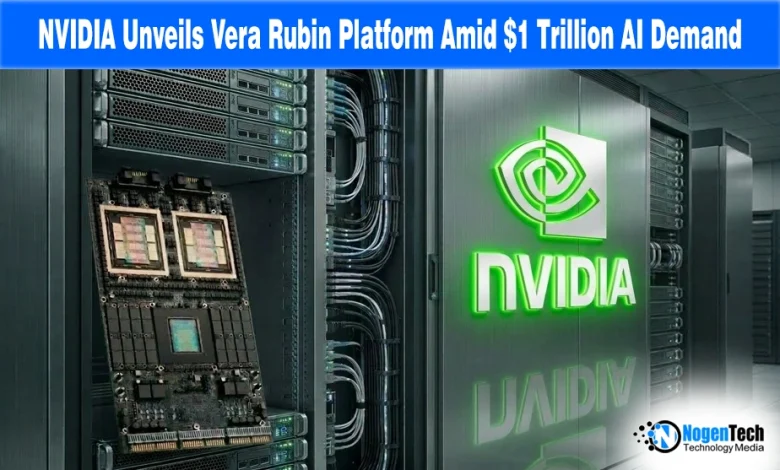
According to NVIDIA’s official newsroom, the Vera Rubin platform is a full-stack computing system comprising seven chips, five rack-scale systems, and one supercomputer built specifically for agentic AI workloads.
The platform includes a purpose-built Vera CPU with 88 cores, each featuring a neural branch predictor, as reported by SiliconAngle. NVIDIA says the Vera Rubin NVL72 configuration delivers 3.6 exaflops of compute, while the higher-tier Rubin Ultra connects up to 144 GPUs in a single rack.
As reported by CNBC, Jensen Huang stated during his keynote that he now expects cumulative purchase orders across Blackwell and Vera Rubin to reach at least $1 trillion through 2027, doubling a prior projection of $500 billion that the company had cited as recently as 2025.
CNBC’s coverage noted the revision arrived after NVIDIA Chief Financial Officer Colette Kress had already flagged in the company’s most recent earnings report that growth this year would exceed earlier guidance. Tom’s Hardware confirmed that Vera Rubin rack-scale systems are scheduled to begin shipping to customers in the second half of 2026.
Goldman Sachs maintained a “Buy” rating on NVIDIA following the conference, citing in an analyst note what it described as a clear and extended growth trajectory in enterprise AI infrastructure demand.
Complementing the platform, NVIDIA’s Groq 3 LPX rack pairs 256 LPUs directly with the Vera Rubin NVL72, delivering up to 35x higher inference throughput per megawatt, as NVIDIA’s investor relations highlighted.
NemoClaw and OpenClaw AI Agents Platform
As noted earlier this month, NVIDIA’s NemoClaw is an enterprise-grade reference stack built atop the open-source OpenClaw AI agent framework, developed in collaboration with OpenClaw creator Peter Steinberger. According to NVIDIA’s official press release, NemoClaw layers enterprise security and privacy controls onto OpenClaw, allowing companies to deploy a compliant AI agent environment through a single command.
Microsoft Security confirmed to NVIDIA’s newsroom that it is partnering with the company on adversarial learning and real-time agent protection within the NemoClaw framework.
DLSS 5 and Gaming AI Advancements
As reported by TechCrunch and confirmed in NVIDIA’s official keynote materials, DLSS 5 introduces end-to-end neural rendering, marking a structural departure from earlier versions that focused on upsampling and frame generation. Under DLSS 5, AI models trained on cinematic datasets generate lighting, surface materials, and geometry details in real time during the rendering pass itself, rather than as a post-processing correction.
Tom’s Hardware reported that a live demonstration at GTC using Resident Evil: Requiem showcased real-time cinematic-quality hair shading, wet-surface reflections, and detailed leather textures that previously required offline rendering pipelines.
According to NVIDIA’s official blog, more than 30 titles, including Assassin’s Creed Shadows, Starfield, Naraka: Bladepoint, and Where Winds Meet, are scheduled for DLSS 5 adaptation this autumn, with studio partners including Bethesda, CAPCOM, NetEase, Tencent, and Ubisoft.
As noted by Tom’s Hardware, DLSS 5 will be compatible with existing RTX hardware through NVIDIA’s Streamline framework, reducing integration costs for developers on current-generation hardware.
NVIDIA’s Space-Based AI Infrastructure Initiatives
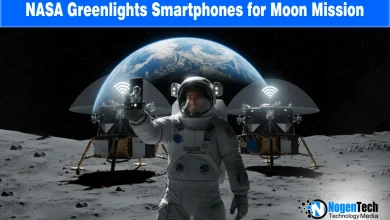
According to CNBC, Jensen Huang announced the Vera Rubin Space-1 Module at GTC 2026, declaring that “space computing, the final frontier, has arrived.” As reported by Investing.com, the Space-1 Vera Rubin Module delivers up to 25 times the AI inference performance of NVIDIA’s H100 GPU for orbital deployment.
The NVIDIA newsroom confirmed the system is engineered for size-, weight-, and power-constrained environments and targets three primary application areas: orbital data centers, advanced geospatial intelligence processing, and autonomous space operations.
As detailed by Data Center Dynamics, the space computing stack comprises three tiers: the Vera Rubin Space-1 Module for high-intensity orbital workloads, IGX Thor based on the Blackwell architecture for edge scenarios, and Jetson Orin for real-time vision and sensor data processing.
IGX Thor and Jetson Orin are currently available, while the Vera Rubin Space-1 Module has no confirmed ship date, as noted by Tom’s Hardware and StockTitan.
NVIDIA is scaling into orbit with the Space-1 Vera Rubin module, partnering with leaders such as Axiom Space and Starcloud. To survive extreme radiation, the system uses “lockstep” paired chips, which help to mitigate radiation-induced errors.
Despite cooling hurdles, shifting from convection to radiation, NVIDIA’s 2026 launch aims to outpace Google’s orbital TPU tests for global AI dominance.
NVIDIA’s Strategic Platform Shift
NVIDIA’s GTC 2026 framed AI as essential infrastructure, comparable to electricity rather than a software layer. CEO Jensen Huang identified 2026 as the critical inflection point for inference demand, fueled by a transition from simple chatbots to complex agentic AI systems that autonomously generate tasks.
According to TechBuzz, the Space-1 initiative moves NVIDIA’s AI “brains” directly into orbit. This bypasses terrestrial latency, the lag caused when data travels between space and Earth-bound servers.
Collectively, these announcements signal NVIDIA’s move to control the compute layer across every physical environment where AI workloads operate, from data centers to deep space.
Jensen Huang and Market Reaction
According to NVIDIA’s official blog, Jensen Huang described the Vera Rubin platform as a system “vertically integrated, complete with software, extended end to end, optimized as one giant system.” On the space initiative, CNBC reported Huang stated: “As we deploy satellite constellations and explore deeper into space, intelligence must live wherever data is generated.”
Reports note that Goldman Sachs maintained a $250 price target on NVIDIA following the conference, citing the Spectrum-X CPO switch production ramp and NemoClaw platform launch as key enterprise deployment signals.
As Market Business Insider reports, NVIDIA’s stock closed up 1.63 percent on March 16, following an intraday gain exceeding 4.8 percent after the keynote concluded.
Baiju Bhatt, founder and CEO of Aetherflux, stated in NVIDIA’s press release that the Space-1 Vera Rubin Module enables autonomous orbital operations powered by solar energy, describing it as unlocking “scalable, space-based AI infrastructure beyond Earth.”
AMD, Intel, and Hyperscaler Response
The competitive landscape is tightening as Tom’s Hardware notes AMD’s Instinct MI400 is gaining favor for cost-efficiency, while Intel challenges with Gaudi 4 and acts as a foundry partner. According to Bloomberg, procurement lead times for high-end AI accelerators have stretched to six months with pricing climbing 10%, driven by what industry leaders call “unprecedented” demand.
In orbit, Data Center Dynamics confirms Google is testing TPU-equipped satellites, and SpaceX plans a million AI satellites using Tesla chips. However, skeptics like Sam Altman and Matt Garman question the economic viability and debris risks of these orbital data centers compared to NVIDIA’s integrated approach.
What Comes Next for NVIDIA
According to NVIDIA’s official blog, the generation following Vera Rubin will be called Feynman, featuring a new CPU named Rosa, an homage to Rosalind Franklin, and designed to advance every layer of what Huang described as the AI factory stack: compute, memory, storage, networking, and security. No launch timeline for Feynman was announced at GTC 2026.
The Vera Rubin rack-scale systems are on track for customer shipments in the second half of 2026. The DLSS 5 integration across more than 30 game titles is scheduled for autumn 2026, as per the company’s statements. While the Space-1 Vera Rubin module will ship at a later date to be announced, according to the NVIDIA newsroom.
Ultimately, these milestones suggest that NVIDIA’s true product isn’t just a chip, but the very infrastructure of the next industrial revolution.
Source: NVIDIA Blog