NASA’s Webb Peers Deep Into the Heart of the Circinus Galaxy
NASA’s Webb telescope has shown that the intense infrared light at the heart of the Circinus galaxy comes mainly from dust feeding its supermassive black hole rather than from material being blasted outward.

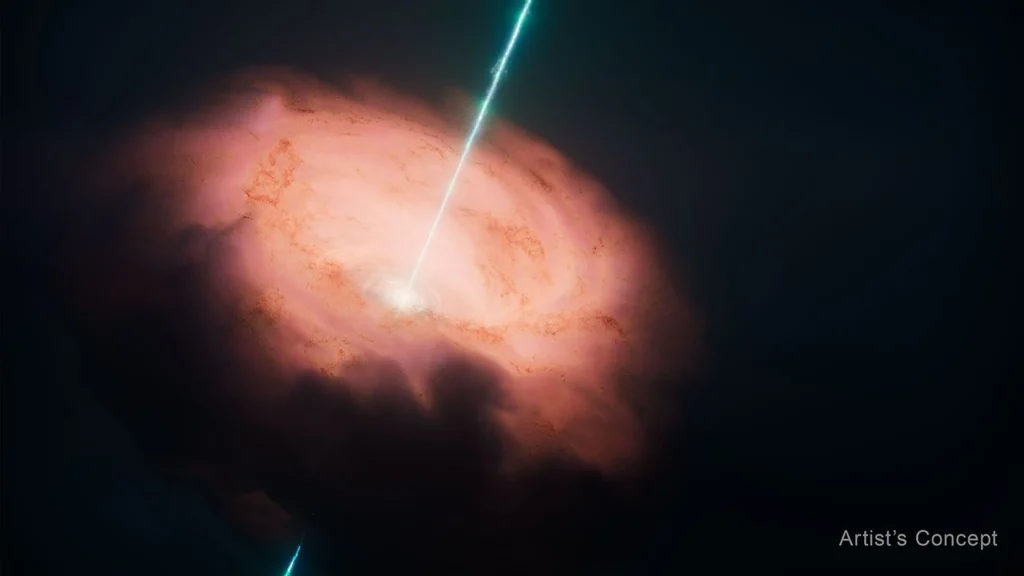
NASA’s James Webb Space Telescope has delivered its most detailed look yet at the turbulent core of the Circinus galaxy. It reveals how a supermassive black hole is being fed by surrounding clouds of hot dust rather than blowing them away as previously believed.
Circinus, located about 13 million light-years from Earth, hosts an active supermassive black hole at its center. For decades, astronomers thought that most of the intense infrared light coming from this region was produced by powerful outflows of superheated material shooting away from the black hole.
But new Webb observations have turned that idea on its head. Using a cutting-edge imaging method, Webb captured the sharpest-ever view of a black hole’s immediate surroundings in another galaxy.
The results, published Tuesday in the journal Nature, show that nearly all of the infrared glow actually comes from hot dust packed tightly around the black hole itself.
A Dusty Engine Around a Cosmic Giant
At the core of Circinus lies a black hole wrapped in a thick, donut-shaped ring of gas and dust called a torus. As this material falls inward, it forms a swirling accretion disk that heats up due to intense friction and emits powerful radiation.
The problem for astronomers has always been that this region is incredibly small, extremely bright, and hidden behind dense dust, which makes it difficult to study with traditional telescopes. Ground-based observatories and earlier space telescopes could detect excess infrared light, but could not tell whether it came from material falling into the black hole or from jets blasting outward.
Webb finally gave scientists the clarity they needed.
A Telescope that Acts Like Many
To make this breakthrough, Webb used a special mode called the Aperture Masking Interferometer on its NIRISS instrument. This technique effectively turns the telescope into a network of smaller telescopes working together, which allows scientists to extract fine details far beyond what a single mirror could normally achieve.
In practical terms, it made Webb behave like a 13-meter telescope instead of its already impressive 6.5-meter size, producing images twice as sharp over a small area of the sky.
By analyzing the resulting interference patterns, the research team reconstructed a high-resolution image of the galaxy’s core, separating light from the torus, the accretion disk, and the outflows for the first time.
The Big Surprise
The data revealed something striking. About 87 percent of the infrared light from hot dust in Circinus comes from material very close to the black hole, inside the torus and accretion region. Less than 1 percent comes from dusty outflows, with the rest coming from more distant structures.
That means most of the glowing dust is not being blown away but is instead feeding the black hole.
“This finally explains the mysterious excess of infrared light we have seen for decades in active galaxies,” said lead author Enrique Lopez-Rodriguez of the University of South Carolina. Earlier models had to guess which components were responsible because the region could not be resolved clearly. Webb changed that.
Opening a New Era of Black Hole Studies
This marks the first time Webb’s high-contrast interferometry mode has been used to study a galaxy beyond the Milky Way, setting the stage for a new way to examine black holes across the universe.
Scientists now plan to apply the same technique to many other active galaxies. Some black holes are much brighter than Circinus, and in those systems, powerful outflows may still dominate the emissions. By comparing dozens of targets, astronomers hope to learn how black hole brightness, feeding rates, and jets are connected.
“We need a larger sample to see whether Circinus is typical or unique,” Lopez-Rodriguez said. “This is just the beginning.”
With this breakthrough, the James Webb Space Telescope once again proves why it is the world’s most powerful space observatory, which offers humanity its clearest window yet into the extreme environments where galaxies and black holes evolve.
Source: Deep Circinus on NASA