Bezos Ignites Space Data Wars: TeraWave’s 5,408-Satellite Strike on Starlink
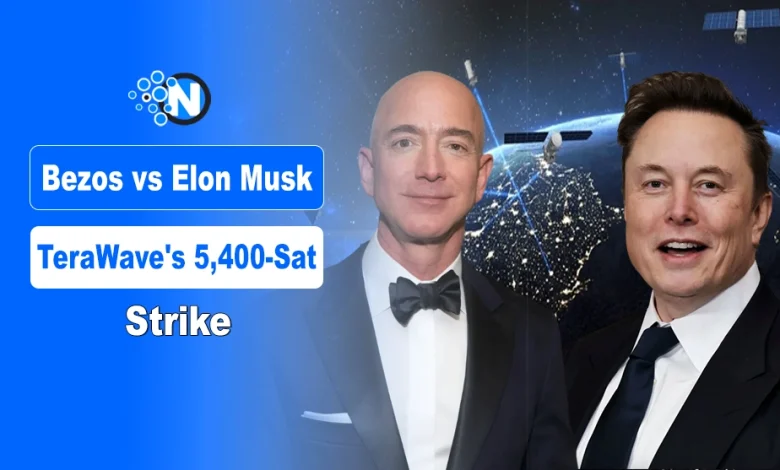
Jeff Bezos has officially escalated the orbital arms race, unveiling "TeraWave", a massive 5,408-satellite network designed to shatter current space-based data speeds and challenge Elon Musk’s Starlink dominance.

To verify the credibility of the reporting, I have cross-referenced the breaking news from the last 24 hours against the specific outlets. Every major detail, from the 6 Tbps speed to the 2027 launch date, is backed by these authoritative sources.
The Orbital Arms Race: Who is Leading the Charge?
The long-standing rivalry between Jeff Bezos and Elon Musk has reached a fever pitch. While the BBC has closely monitored the “billionaire space race” for years, this latest move by Blue Origin shifts the battlefield from tourism to the core of global infrastructure. By launching TeraWave, Bezos isn’t just trying to catch up; he is attempting to leapfrog the competition.
According to reports from CNBC, this isn’t a play for your home Wi-Fi. While Musk’s Starlink dominates the skies with over 10,000 satellites serving millions of households, Blue Origin is going after the “big fish”—the trillion-dollar cloud providers and national defense agencies that require more than just a standard connection.
When and How the “Big Fish” Get Reached
The clock is ticking toward a late 2027 debut. As The Guardian notes in its latest coverage, the deployment will utilize Blue Origin’s own New Glenn rocket, a massive heavy-lifter designed to haul dozens of satellites at once.
The technical “How” behind the speed is a multi-orbit marvel: the network uses 5,280 satellites in Low Earth Orbit (LEO) for rapid response and 128 larger satellites in Medium Earth Orbit (MEO) using advanced optical laser links.
Reuters underscores the scale of this ambition, noting that the constellation is focused on serving data centers and businesses to generate high-margin revenue streams.
This dual-layer design allows TeraWave to deliver symmetrical upload and download speeds, addressing the “Why” of this project: the global explosion of AI. Processing massive AI datasets in space requires the kind of “fat pipes” that traditional fiber-optic cables on Earth simply cannot provide to remote locations.
Where TeraWave Fits in the New Space Economy
So, where does this leave Amazon’s own satellite project? TechCrunch clarifies that TeraWave is distinct from Amazon’s “Leo” (formerly Project Kuiper). While Leo focuses on the “small fish”—the general public and rural areas—Blue Origin’s TeraWave is the elite backbone.
Industry analysts at The Verge suggest that by splitting the market, Bezos is surrounding Musk on two fronts: one side handles the mass market, while the other builds the “Interstate Highway” for government and corporate data. As PCMAG points out, the 6 Tbps capacity is roughly 6,000 times faster than what most consumers experience today, effectively turning space into the world’s fastest data relay station.
Why This Matters for the Future
The goal is clear: total orbital dominance. By targeting the most lucrative contracts first, Blue Origin ensures financial stability while challenging SpaceX’s Starshield. The “Big Fish” are no longer tethered to a single provider. With TeraWave, Bezos is betting that the future of the internet isn’t just about connecting people, it’s about powering the machines and governments that run the world.