
Elon Musk Pulls Back the Curtain: X Launches Phoenix Algorithm to Global Scrutiny
Elon Musk has officially released the source code for X’s new recommendation engine today. By exposing the platform's inner workings, Musk is betting that radical transparency will fix a system he openly admits is currently "clumsy" and "dumb."

Key Takeaways
- The “Glass Box” Strategy: X has uploaded its production-level “Phoenix” algorithm to GitHub, allowing the public to audit the exact logic that determines which posts go viral and which disappear.
- The Death of Human Tuning: The new system officially scraps manual “heuristics” (manually written rules), replacing them with a sophisticated Transformer architecture mirrored after the xAI Grok model.
- Commitment to Iteration: Moving forward, X will publish updated code and developer “patch notes” every four weeks, treating social media ranking like a living software project rather than a static secret.
The official open-sourcing of the X algorithm today, January 20, 2026, represents a pivotal moment in the “AI arms race.” While most social giants guard their ranking logic like the crown jewels, Musk is inviting developers to watch X “struggle in real-time” to improve a flawed system.
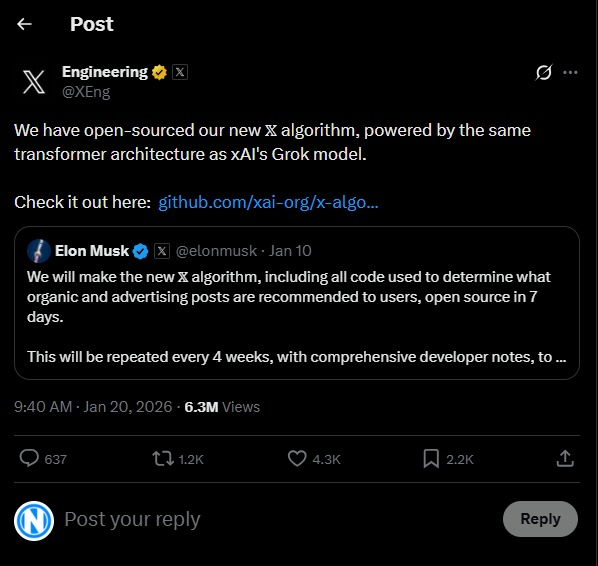
By making both organic and advertising recommendation code public, the platform is attempting to distance itself from the “black box” reputations of competitors like Meta and TikTok.
Why This Move Defies Industry Logic
In the traditional tech world, revealing your algorithm is seen as giving a roadmap to bad actors and spammers. The “norm” is to keep the logic hidden to prevent platform manipulation.
Musk is flipping that script. Today, he characterized the current state of X’s recommendations as “dumb,” arguing that by showing the world the “messy” reality of the code, the community can help refine it faster. This level of corporate vulnerability, admitting a flagship product is currently underperforming while showing exactly how it’s broken, is almost unprecedented in the Fortune 500 space.
The “Phoenix” Architecture: A New AI Frontier
Technical documentation released with the code confirms that the Phoenix model is a total departure from the “Twitter” era. It no longer relies on a list of “if-then” rules created by humans.
- The Engine: It utilizes a Transformer-based architecture, the same tech underlying models like ChatGPT and Grok.
- The Reputation Score: The code reveals an invisible “Reputation Score” for every user (ranging from -128 to +100). This score dictates how far a post can travel before it even hits the main feed.
- 15-Point Prediction: For every post you see, the algorithm has predicted 15 different ways you might react (like, reply, or even “dwell time”) and weighted them into a single final score.
Deflecting Regulatory Heat
Beyond the “transparency” narrative, this release is a calculated move against mounting legal pressure. X is currently navigating a “retention order” from the European Commission that lasts through 2026, alongside heavy fines from the EU regarding the Digital Services Act (DSA).
By providing “live” visibility into its systems, X is essentially handing regulators the keys to the building before they can kick the door down. This “open-door” policy in France and the UK is designed to prove that the platform is fighting bias with math, not with hidden political agendas.
The Tesla-fication of Social Media
The new four-week update cadence mirrors the software-first approach seen at Tesla. Instead of static policy updates, users will now receive “comprehensive developer notes” that explain exactly why their feed changed.
This shift signals a new era for X leadership. Rather than defending “shadow banning” through PR statements, the company’s new stance is: “The code is on GitHub. If you don’t like the result, help us find the bug.”

![Top Tech Stories of 5th week [2026]](https://www.nogentech.org/wp-content/uploads/2026/02/Top-Tech-Stories-of-5th-Week-2026-390x220.webp)